What can be seen inside the Sansevero Chapel
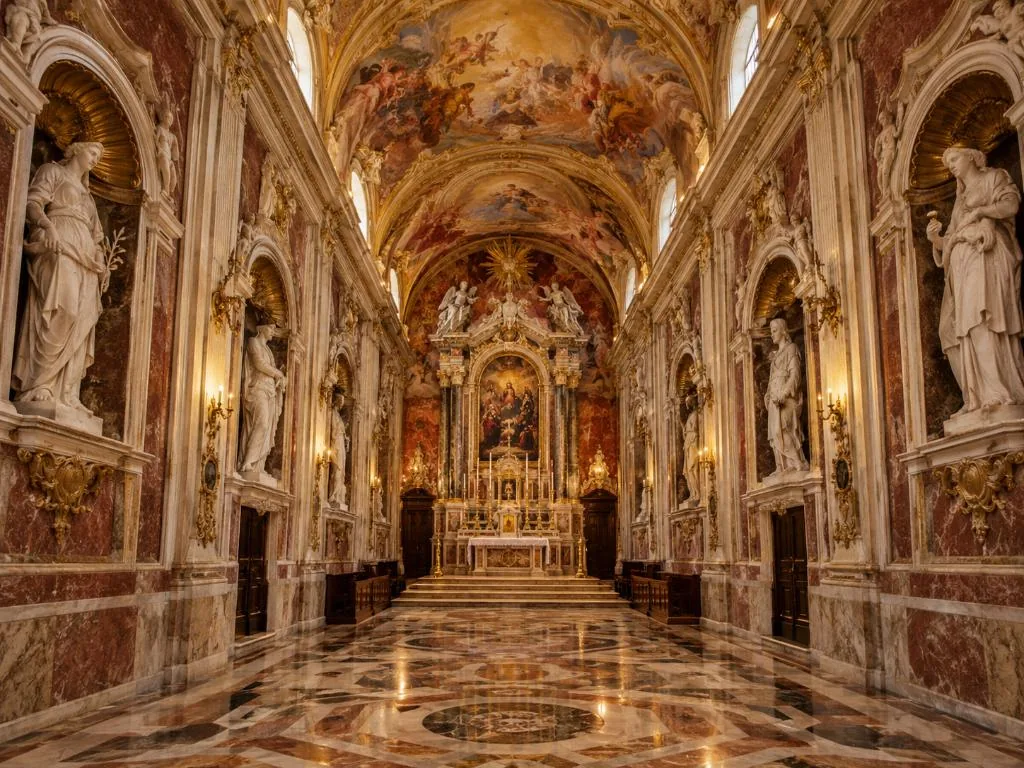
The visit to the Sansevero Chapel follows a nearly fixed route, short but dense: the nave, the Veiled Christ at the centre, the statues of the Virtues on the sides, the frescoed vault above, a fragment of the labyrinth floor towards the exit, and finally the underground Cavea with the anatomical machines. I describe it here in the order in which you actually see it, so you know what to expect even before entering.
The nave and the Veiled Christ
You enter through the nave, a single space in Neapolitan Baroque style. At its centre stands Giuseppe Sanmartino’s Veiled Christ, carved in 1753 from a single block of marble: I describe it in full in the Veiled ChristAround the walls and in the corners are the other works commissioned by Raimondo di Sangro: Saint Rosalia, Saint Oderisius, the monument to Cecco di Sangro, that to Alessandro di Sangro, the high altar and the monuments to the Princes of Sansevero.
Modesty
On the right of the nave stands Pudicizia, also called Veiled Truth, carved by Antonio Corradini in 1752: the monument to Raimondo’s mother, Cecilia Gaetani dell’Aquila d’Aragona, who died on 26 December 1710. The veil clinging to the body, the garland of roses, the broken gravestone and the tree of life tell of a life cut short. On the pedestal is a bas-relief of Noli me tangere.
Disillusion
On the left stands Disinganno, by Francesco Queirolo, created between 1753 and 1754: the monument to Raimondo’s father, Antonio, Duke of Torremaggiore. A man frees himself from a marble net carved so finely that the craftsmen of the time refused to finish it for fear of breaking it; Queirolo polished it alone with pumice. The winged putto with the flame on its forehead is the intellect, the globe represents earthly passions, the open Bible is sacred truth. The bas-relief shows Jesus restoring sight to a blind man.
The ten Virtues
In addition to Pudicizia and Disinganno, Raimondo di Sangro wanted eight more Virtues to complete the cycle: Gentleness of the Conjugal Yoke, Sincerity, Zeal for Religion, Self-Control, Generosity, Education, Decorum, Divine Love. Each is dedicated to a family member, with symbolic language that a guide can interpret far more quickly than one can alone in a few minutes.
The vault and the labyrinth floor
Above, the vault is frescoed with Francesco Maria Russo’s Glory of Paradise, from 1749, never restored: the colours are the original ones, slightly darkened by time. Of the labyrinth floor in white and blue marble, only a portion remains, in the passage to the Cavea: an initiatory symbol, the path to knowledge, one of the many philosophical references Raimondo di Sangro scattered throughout the Chapel.
The Cavea and the anatomical machines
The final stop is the underground Cavea, accessible via a narrow spiral staircase: here stand the two anatomical machines, the skeletons with the reconstructed circulatory system that are perhaps the most debated part of the visit. The space is not wheelchair-accessible: the detail is in accessibility and the full account in the anatomical machines.
If time is short, don’t skip the vault to rush towards the Cavea: looking up before descending is the only moment when the nave can be seen all at once, without people in front.
What you won’t see, and why
Don’t expect multiple rooms, corridors or floors to explore: the Sansevero Chapel is a single nave plus the underground Cavea, that’s all. Those arriving expecting a large museum with dozens of spaces are taken aback by its actual size. It’s also why the self-guided visit lasts about twenty minutes rather than an hour: there’s physically little space to walk through, even if what it contains is dense.
With or without a guide, what changes in the viewing
The physical route is identical with or without a guide: what changes is how much you can read into the symbols. The globe beneath the figure of Disinganno, the bas-relief of Noli me tangere beneath Pudicizia, the meaning of each individual Virtue among the ten: on your own you see them, with a guide you understand them. The comparison of guided options is in which is the best tour.
A route designed to be read, not just looked at
Raimondo di Sangro placed every piece according to a precise logic: the Virtues on the sides tell the story of the family, the Veiled Christ at the centre concludes the iconographic programme on sacrifice, the labyrinth towards the exit suggests the path of knowledge completed by crossing the Chapel. It’s not a random arrangement: it’s a text written in marble, which can be read in a few minutes if you know where to look.
Frequently asked questions
What’s inside the Cappella Sansevero?
A single nave with the Veiled Christ at the centre, the statues of Pudicizia and Disinganno and eight other Virtues, the frescoed vault and a fragment of labyrinth floor, and finally the underground Cavea with the anatomical machines.
What are the statues of Pudicizia and Disinganno?
These are the monuments to Raimondo di Sangro’s parents: Pudicizia to his mother, Disinganno to his father. The detail of both is above, and the family context is in Raimondo di Sangro.
What is the visiting order for the Sansevero Chapel?
Nave with the Veiled Christ, the Virtues on the sides, the vault, the labyrinth floor towards the exit, and finally the Cavea with the anatomical machines, if accessible during your visit.
How much time is needed to see everything?
The nave alone can be seen in about twenty minutes; with a guide explaining each piece, the minimum time required is 35 minutes. The details are in how long the visit lasts.