The anatomical machines in the underground Cavea
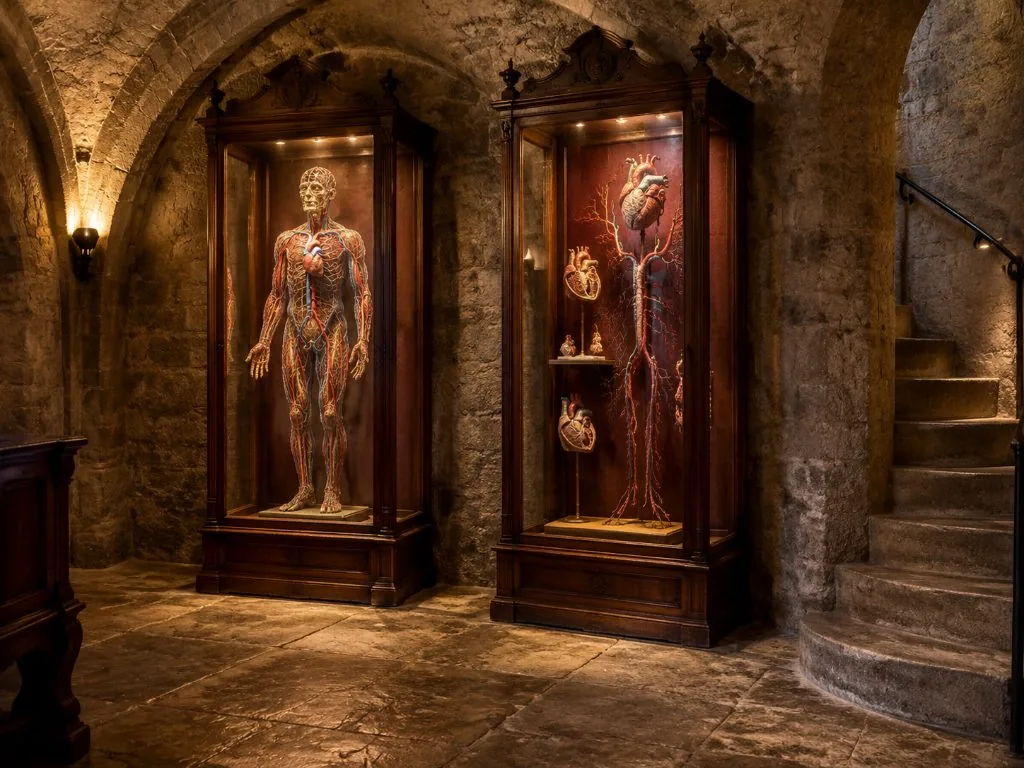
The anatomical machines are two complete skeletons, a man and a woman, standing inside two display cases, with the arterial-venous system almost entirely preserved around the bones. They are located in the underground Cavea, the space reached via a narrow spiral staircase after viewing the Veiled Christ and the statues in the nave. They are the most divisive part of the visit: some find them the most fascinating aspect of the Chapel, while others prefer not to look too closely.
Who made them, and why
The creator was Giuseppe Salerno, a Sicilian physician active between approximately 1756 and 1764. Raimondo di Sangro purchased the male specimen in 1756 after it was displayed in a public exhibition in Naples, and later commissioned the female one as well. The circulatory system visible around the bones is not organic: it is reconstructed using various materials, including beeswax and dyes, assembled with such precision that for two centuries it has fuelled doubts about how it was actually achieved.
The dark legend, and what science says
A grim legend has grown around the anatomical machines: that Raimondo di Sangro had servants killed to use their bodies as a base. This story is still told today, but it is just that—a legend, not a documented fact. In 2008, a team of researchers from University College London was granted permission to examine the two skeletons using modern techniques. The result: the skeletons are real, while the circulatory system is artificial, constructed separately and mounted onto the bones. It is hypothesised that the reconstructions were preceded by injection tests on different materials, not on living people. At the feet of the female figure, there was once a foetus with its placenta, the remains of which have since been stolen: all that remains is the empty space where it once lay.
Why the Crypt is not for everyone
The nave, where the Veiled Christ is located, is wheelchair-accessible, as is the sacristy with the bookshop. The Crypt is not: access is via a narrow spiral staircase, and there is no alternative route. Those with mobility difficulties can still see everything else in the Sansevero Chapel; the anatomical machines remain the only inaccessible part. I discuss this in more detail in accessibility and wheelchair use.
If the legend of murdered servants is the reason you want to see them, be prepared to be somewhat disappointed: what you will find is an 18th-century scientific reconstruction, not a macabre exhibit. Still interesting, but for a different reason.
What to see before you get there
The anatomical machines are the final stop on the visit, after the Veiled Christ and the statues of the Virtues. The full order is in what you see inside the Sansevero ChapelFor context on who commissioned them and why, and how this ties in with the prince’s reputation as an alchemist, see the story of Raimondo di SangroParents with children will find this the stop that impresses them the most: the detail is in visiting with children.
What you notice up close
The two display cases stand side by side, the man and woman upright, with the entire network of vessels running from the neck to the feet. What strikes you is not just the amount of detail but the consistency: arteries and veins are distinct, with a path that truly follows human anatomy, not a decorative approximation. It is a work designed to be studied up close, not merely observed from a distance with a certain awe.
Why it helps to know the story before going down
Those who descend into the Cavea without context risk stopping only at the immediate reaction, somewhere between fascination and unease, without grasping what makes the anatomical machines truly interesting: the technical precision of an 18th-century reconstruction made without the tools available to medicine today. A guide who recounts Giuseppe Salerno’s story before going down changes what you see once you stand in front of the display cases, and makes it easier to separate what is documented from what is merely legend passed from one tourist to another.
What remains unanswered
Not everything about the anatomical machines was clarified by the 2008 study: the exact method Salerno used to fix the network of vessels to the bones without damaging them remains uncertain, a process researchers have not been able to reconstruct in technical detail. This is one of the reasons why the anatomical machines continue to be the subject of study today, not just a museum curiosity.
Frequently asked questions
Are the anatomical machines real?
Skeletons are real; the circulatory system enveloping them is an artificial reconstruction made with various materials, including beeswax. This was confirmed by the 2008 study by University College London.
Is it true that Raimondo di Sangro killed servants to create them?
No, it remains a legend without documented evidence. The reconstructions were likely preceded by technical tests on materials, not on people. The context is in who Raimondo di Sangro was.
Are the anatomical machines wheelchair accessible?
No, they are located in the underground Cavea, accessible only via a narrow spiral staircase. The rest of the Sansevero Chapel is: see accessibility.
Who created the anatomical machines?
The Sicilian physician Giuseppe Salerno, between approximately 1756 and 1764, commissioned by Raimondo di Sangro.