The Veiled Christ by Giuseppe Sanmartino
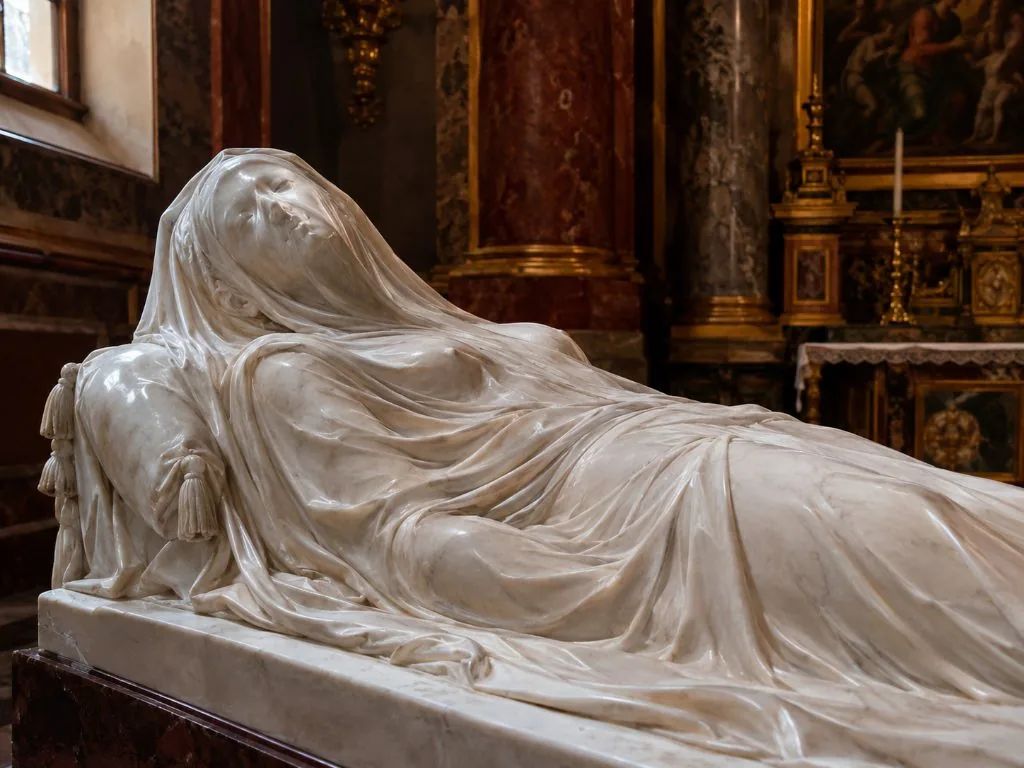
The Veiled Christ is the sculpture at the centre of the nave of the Sansevero Chapel: a reclining body, covered by a veil that appears to be damp fabric but is in fact marble, the same block as the body. It was created by Giuseppe Sanmartino in 1753, commissioned by Raimondo di Sangro, seventh Prince of Sansevero. It is the work for which visitors book a time slot months in advance, and up close you understand why.
The commission that was meant to have another name
The Veiled Christ project did not originate with Sanmartino. Raimondo di Sangro first entrusted it to Antonio Corradini, who, however, died in 1752 after leaving only a sketch. The commission then passed to Sanmartino, who had already worked on Neapolitan nativity scenes and found himself completing the most debated work of the 18th century in Naples. Corradini’s sketch can still be seen in the overall composition of the figure, but the rendering of the veil is entirely Sanmartino’s.
The veil is not fabric (and it is not magic)
For centuries, a legend has circulated: that the veil was real fabric, made transparent by an alchemical process invented by Raimondo di Sangro himself. It is a compelling story, but it is not true. The accounting document signed by Raimondo di Sangro, who paid for the work, describes it as follows: «a marble statue sculpted life-size, representing Our Lord Jesus Christ deceased, covered by a transparent shroud carved from the same block as the statue». Body and veil emerge from the same piece of marble. He wrote this himself, with his signature on a payment document, not a tourist impressed three centuries later.
What Raimondo di Sangro himself thought of it
In his writings, the prince described Sanmartino’s work as «executed with such art as to astonish the most skilled observers». Coming from a man who had commissioned anatomical machines and experimented with materials his entire life, this is not a casual compliment.
Because it is a technical masterpiece, not just an emotional one
Carving a marble veil that appears to cling to the skin beneath, following every fold of the body without detaching from the block and without uniform thickness, is a technical as well as artistic challenge: a miscalculation in thickness and the marble breaks. Sanmartino solved it at a time when Naples was mainly carving nativity scenes. This is one of the reasons why the statue remains a reference point for those studying Baroque sculpture, along with Francesco Queirolo’s Disinganno, in the same chapel, with its marble net carved so thinly that the craftsmen of the time refused to finish it.
How to view it when time is short
The nave is small and, during busy time slots, viewing is often done in turns. My advice is to move closer to the face and hands, where the marble thins to the point of seeming wet, then take two steps back to see the whole: the body, the cushion, the symbols of the Passion at the statue’s feet. Those visiting during less crowded times have more room to do this at their own pace: the detail lies in when to visit. Photography is not allowed, so it’s better to look rather than search for the right shot: here you can find the reason for the rule on photos and videos inside the Chapel.
If someone asks for a souvenir photo, take it outside: in Piazza San Domenico Maggiore, just after leaving, you can still see the emotion on people’s faces. Inside, keep it to yourself.
The rest of the Chapel
The Cristo velato is the most famous piece but not the only one. In the same nave are the statues of the Virtues commissioned by Raimondo di Sangro, starting with Pudicizia and Disinganno, and below, in the Cavea, the two anatomical machines, a separate chapter: I describe them in what you can see inside the Sansevero Chapel and in the anatomical machines. To understand why Raimondo di Sangro built all this, and why a legend of him as an alchemist arose, there is his story. If you're wondering whether it's worth going, the straightforward answer is in the Veiled Christ is worth seeing.
What people say when they see it for the first time
In guided tour reviews, the same words often recur for the Veiled Christ. Leona, from the UK, called it one of the most impressive things she had ever seen; Teresa, from the US, wrote that the guide was very knowledgeable and that she learned a great deal right in front of the statue. These are not brochure phrases: they are spontaneous reactions from people who entered without specific expectations and left amazed by a piece of marble.
A detail almost no one notices immediately
Looking at the face of the Veiled Christ, the veil follows even the smallest features: the eyebrows, the fold of the slightly parted lips, the veins on the back of the hand. It is this, more than the statue’s size, that explains why visitors have been stopping for three centuries to search for a seam that isn’t there. Those arriving with a guide are usually stopped at this very point, even before explaining the history of the 1753 document.
Frequently asked questions
Who sculpted the Veiled Christ?
Giuseppe Sanmartino, in 1753, commissioned by Raimondo di Sangro. The task had initially been assigned to Antonio Corradini, who died in 1752 after leaving a sketch. The rest of the story is in who Raimondo di Sangro was.
Is the veil of the Veiled Christ made of marble or fabric?
Of marble, and it is not a separate piece: body and veil emerge from the same block, as Raimondo di Sangro himself wrote in the payment document for the work. The legend of the fabric made transparent through alchemy is just that—a legend.
Where is the Veiled Christ located inside the Chapel?
In the centre of the nave, the first area you visit. For the complete order of the rooms, see what you see inside.
Can photos be taken of the Veiled Christ?
No. Photography and video recording are strictly prohibited inside the Chapel, without exception: I explain this in are photos allowed.